


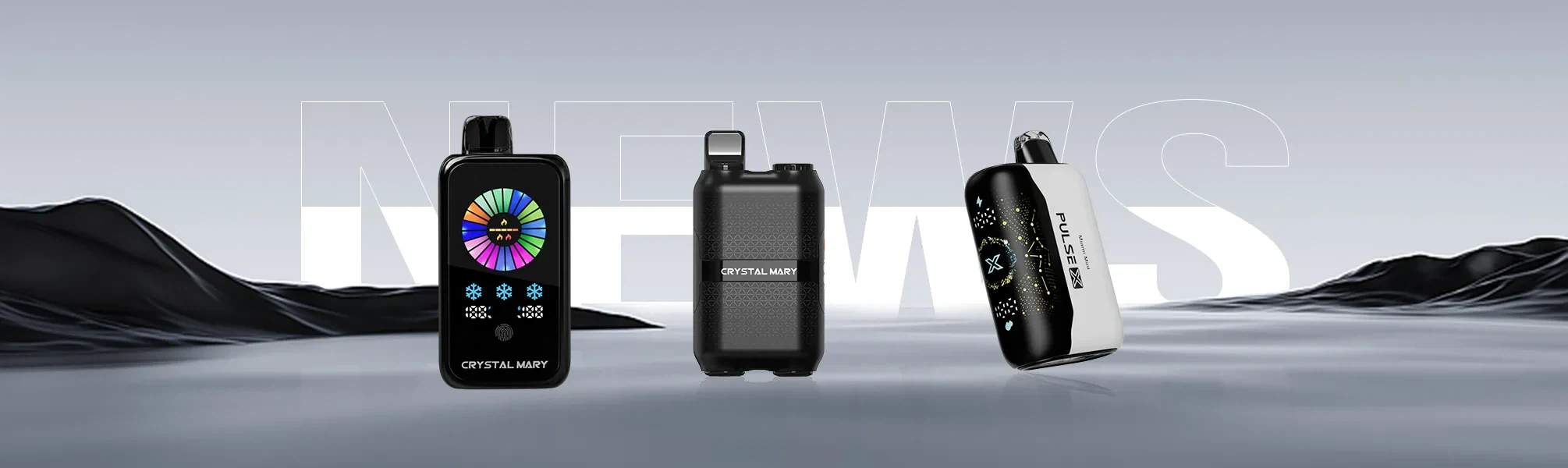
Why Disposable Vapes With Screens Are Becoming A New Trend in The High-Puff Vape Market
The trend is closely tied to changes inside high-puff devices. Larger reservoirs, rechargeable batteries, mesh coils, adjustable output, and chip-controlled operation have made them more capable, but also more complex. A screen gives users a simple way to monitor that hardware.

Why Is a Vape With Screen Useful in the High-Puff Market?
A basic disposable may be finished before detailed monitoring becomes important. A high-puff device can remain in service for days or weeks, depending on its capacity and the user's draw pattern. During that time, the battery may require several charging cycles while the reservoir continues supplying e-liquid.
A vape with a screen makes that longer service period easier to manage. Common displays on vape devices will show things like the battery percentage, the e-liquid percentage that's left in the tank, how many puffs you've had, charging, what power mode you're on, and fault indicators. Note that not all devices will have all of these indicators, and some may have additional ones. Look at the icons displayed on the screen and check the specifications for the product you're interested in to get a better idea of what it can do, as display size is not everything.
How Does the Screen Monitor Each Puff?
Most draw-activated products use an airflow sensor. When the user inhales, the sensor detects a pressure change and signals the control chip to power the heating coil. The same activation can be recorded as one puff and used by the software to estimate consumption.
The counter is useful, but it does not measure identical quantities of e-liquid on every draw. A three-second inhale keeps the coil active longer than a one-second inhale. Higher-output modes also use more battery energy and liquid per activation. Puff figures should therefore be treated as planning references, not exact personal totals.
Are Battery and E-Liquid Readings Equally Accurate?
Battery readings are generally more dependable because the chip can monitor electrical voltage. During extended use, the percentage reading may fall but recover somewhat on standing. Note that cold and the age of the battery can affect the reading, but it should give some indication of a high, medium, or nearly empty charge.
liquid indicators work differently. Most sealed disposables do not contain a float or optical gauge that directly measures liquid volume. The chipset usually estimates consumption from activation count, heating duration, power mode, and expected liquid use. This is why a display may reach zero while a small amount remains in the wick.

Does a Disposable Vape With Screen Improve Daily Use?
The strongest benefit is fewer surprises. A visible battery percentage tells users when to prepare for charging. A low-liquid warning indicates that replacement may soon be necessary. This is particularly useful during travel, long workdays, or other situations where a charger or replacement device may not be available.
The screen can also help diagnose weak performance. If vapor production falls while the battery reading remains high, the cause may be low e-liquid, restricted airflow, poor wicking, or coil condition. If the liquid reading appears normal but the battery is nearly empty, charging is the logical first step.
The display should still be checked against physical performance. Instead, pay more attention to a persistent burnt taste, major flavor loss, excessive heat, leaking, or electrical warning than to the percentage shown on the screen that reassures you that there is still liquid in the device. Instead, a sealed disposable should never be opened, punctured, or refilled in an attempt to recover any residual liquid from the device.
Why Are Vape With Touch Screen Models Appealing?
A vape with a touch screen combines status information with direct control. Depending on the model, users may be able to switch power modes, adjust airflow settings, view puff records, or lock the interface.
This type of control is worthwhile when it supports a real operating choice. A lower power mode may provide cooler vapor and slower battery consumption. A higher setting can deliver a warmer, denser draw, but it will normally consume e-liquid and power faster. The device must manage these modes consistently; a touch interface cannot compensate for unstable output or poor atomization.
Touch controls are not automatically better than a standard display. Small menus can be awkward, and an exposed screen may register accidental input while carried in a pocket or bag. A practical design needs a screen lock, short timeout, readable icons, and a responsive interface. For many users, two clearly presented settings are more useful than a long menu of marginal adjustments.

What Should Buyers Check Beyond the Screen?
Screen size is an easy feature to compare, but it doesn't tell you much about the actual quality of a vapor's performance. A reliable high-puff vapor is made up of many parts, including the battery, control chip, coil, wick, reservoir, airflow path, and sealing structure. They all have to work together properly to provide great vapor and performance.
Battery and e-liquid capacity should be considered as a pair. A large reservoir needs a rechargeable battery capable of supporting the coil throughout the device's intended life. Battery capacity is measured in mAh, but a larger number does not guarantee better endurance. Output power, coil resistance, display behavior, and draw duration also influence the time between charges.
The coil and airflow design is just as important as the mesh heating elements. The mesh elements spread the heat over a larger surface area, which is better for vapor production. The wick must feed the liquid to the coil at the rate it is vaporized by the coil. If this balance is not good enough, then you may get poor flavor, dry hits, or even leakage despite the device looking to be working properly.
Buyers should also look for effective sealing, a well-fitted mouthpiece, condensation control, chip-based protection, and clear charging instructions. Advertised puff capacity remains a test-based estimate. Real use varies with puff length, airflow, selected mode, temperature, and frequency.

How Does Crystal Mary Develop Screen-Equipped Products?
At Crystal Mary, we treat the display as part of the device-management system, not simply as decoration. Our development work can cover screen layout, battery and reservoir configuration, airflow, coil selection, exterior materials, finishes, nicotine options, and packaging. Final specifications must also be adapted to the regulations of the destination market.
Our published disposable configurations range from 20,000 to 66,000 stated puffs, with model-specific battery and liquid capacities. For example, Pulse X pairs an 820 mAh rechargeable battery with 23 mL of e-liquid, while Groove uses a 1,000 mAh battery and a 28 mL capacity. These are product specifications established under defined conditions; actual use still depends on draw duration, output mode, airflow, and frequency.
Production support includes automated assembly, leak testing, puff-cycle simulation, electrical performance inspection, and appearance checks. Packaging and delivery requirements can be coordinated for different orders, but display accuracy, sealing, and stable atomization remain the more important product controls. For Crystal Mary, the screen is useful only when the hardware behind its readings performs consistently.
FAQ
Q: What is the main benefit of a disposable vape with screen?
A: It reduces guesswork by showing information such as battery charge, estimated e-liquid level, puff activity, or operating mode. Users can prepare for charging or replacement before performance drops unexpectedly.
Q: Is the puff count on a vape exact?
A: No. The counter records activations, but individual draws vary in length and intensity. High-output modes and open airflow can also increase consumption per puff.
Q: Why does an e-liquid indicator show zero while the device still works?
A: The reading is usually calculated by an algorithm rather than measured directly inside the reservoir. Conservative calibration may reach zero while a small amount of liquid remains in the wick. Stop using the device if the flavor becomes dry or burnt.
Q: Does a touch screen use a lot of battery?
A: The display uses some energy, but the heating coil is normally the largest power demand. An efficient screen stays illuminated briefly and enters standby when it is not needed.
Q: Are all high-puff vapes with screens rechargeable?
A: Many are rechargeable because a single battery charge may not support the full reservoir capacity. This is not universal, so users should confirm the charging connection and follow the product's instructions.


