


What Is The Lowest Nicotine Disposable Vape
The lowest nicotine disposable vape tends to be a nicotine-free option at 0 percent. This holds in places where such devices can be sold legally. Among those with nicotine, the 1 percent strength, or 10 mg per mL, sits below the common 2 percent or 20 mg per mL level. Makers design these low-nicotine vapes for grown users seeking reduced nicotine amounts in each milliliter. They still offer the easy prefilled and draw-activated setup of a disposable unit. Stock levels differ a lot from one nation to another. Because of this, buyers should focus on the actual label and local rules rather than loose terms like light.
A lot of disposables containing products with 0% nicotine, 1% nicotine, 2% nicotine, and 5% nicotine are compared by consumers. For example, a 2% nicotine disposable contains 20mg of nicotine per mL of liquid, while a 5% nicotine disposable contains approximately 50mg of nicotine per mL of liquid. Strength alone does not show total intake. All of the above points affect the extent to which a person is exposed to e-liquid when vaping. Vaping products are intended for adults only. No nicotine-containing products are completely risk-free.
What Counts as a Low Nicotine Disposable Vape?
In daily retail talk, low nicotine usually points to a product below the market norm. That may mean 1 percent or 2 percent, where 5 percent disposables dominate. 2% nicotine e-liquid in areas that cap at 20 mg/ml of nicotine: It just gets you to the maximum allowed concentration for nicotine e-liquid. 2% nicotine e-liquid and 1% nicotine e-liquid are your lowest nicotine concentration e-liquids. Always refer to the concentration printed on the label and never the color and/or flavor and/or smooth nature of the e-liquid and related claims.
How Do Percentages Convert to mg/mL?
A simple rule works here. 1% nicotine = 10mg/mL, 0.5% nicotine = 5mg/mL, 2% nicotine = 20mg/mL, 5% nicotine = 50mg/mL. The concentration of your nicotine solution is listed above as a number. This is a concentration of nicotine in solution and does not equal the amount of nicotine in each puff of e-liquid. Nicotine as a freebase can be quite harsh in e-liquid, but as nicotine salts it can be much milder at the same concentration.
Is Zero Nicotine Always the Lowest Option?
By the numbers, yes. Zero percent holds no added nicotine. It is not a quit aid, though. Product quality still counts. Adults who cut nicotine should skip longer or more frequent draws to make up for it. They should seek medical advice for any structured plan.

How Do Disposable Vapes With Low Nicotine Compare?
The table sets concentration apart from likely use. Exact delivery shifts with each device and user, so the table guides label checks more than dose guesses.
|
Label |
Equivalent |
Typical position |
Key consideration |
|
0% |
0 mg/mL |
Lowest possible |
No nicotine, but still an aerosol product |
|
1% |
10 mg/mL |
Low |
Less common in disposable ranges |
|
2% |
20 mg/mL |
Low to moderate by global comparison |
Legal ceiling in some markets |
|
5% |
50 mg/mL |
High |
May feel smooth when formulated with salts |
Which Disposable Vape With Less Nicotine Fits Your Goal?
For Moving Down From 5% Nicotine
A 2 percent choice cuts concentration a good deal from 5 percent. Satisfaction may shift, though. Match items closely. Keep volume, airflow, coil, and draw the same. Changing things one step at a time is usually easier to gauge than switching to different strength, flavor, and device all at once.
For Occasional or Social Use
A 0 percent or 1 percent choice avoids or limits nicotine. Convenience can still lead to unplanned use. Pick a device with clear labeling. Track how often you use it rather than treat a low number as free use.
For Adult Smokers Seeking an Alternative
The best low-nicotine disposable vape is not always the lowest number. A strength that leads to constant extra puffs may miss the goal. Adults who want to stop smoking or vaping can ask a health professional about approved quit products and a clear step-down plan.
What Should You Check Before Buying a Low Strength Disposable Vape?
Check the nicotine value in both percent and mg per mL. Also note e-liquid capacity, battery size, charge status, coil resistance, airflow, and any required warnings. Puff counts are only estimates. They change with draw length and power. Mesh heating spreads heat over more area. The wick, airflow path, and battery output all impact vapor consistency. A sealed mouthpiece and good condensation control also help prevent leaks.
Quality checks go beyond looks. Good supplier checks cover electrical safety, leak and pressure tests, ingredient records, batch tracking, and proper lithium battery shipping papers. Buy only through legal adult channels. Keep devices away from children and pets. Follow local rules for battery disposal.
Why Does Device Design Change the Experience at the Same Strength?
Two disposables labeled 2 percent can feel different. A tighter mouth-to-lung draw will generally produce less vapor per puff than a looser setting. This is influenced by a number of factors, including the coil resistance, surface area, voltage, e-liquid mix, and length of puff. Throat feel or 'harshness' of nicotine does not accurately measure the concentration of nicotine in a nicotine salt mix. Check the printed strength first. Then review the hardware and your own use pattern.
Battery size mainly sets runtime, not nicotine level. Rechargeable models may let a device empty its e-liquid more fully. This can raise total use even when the listed strength stays low. That is why concentration, liquid volume, and behavior must be viewed together.
What Low Nicotine Options Does Crystal Mary Offer?
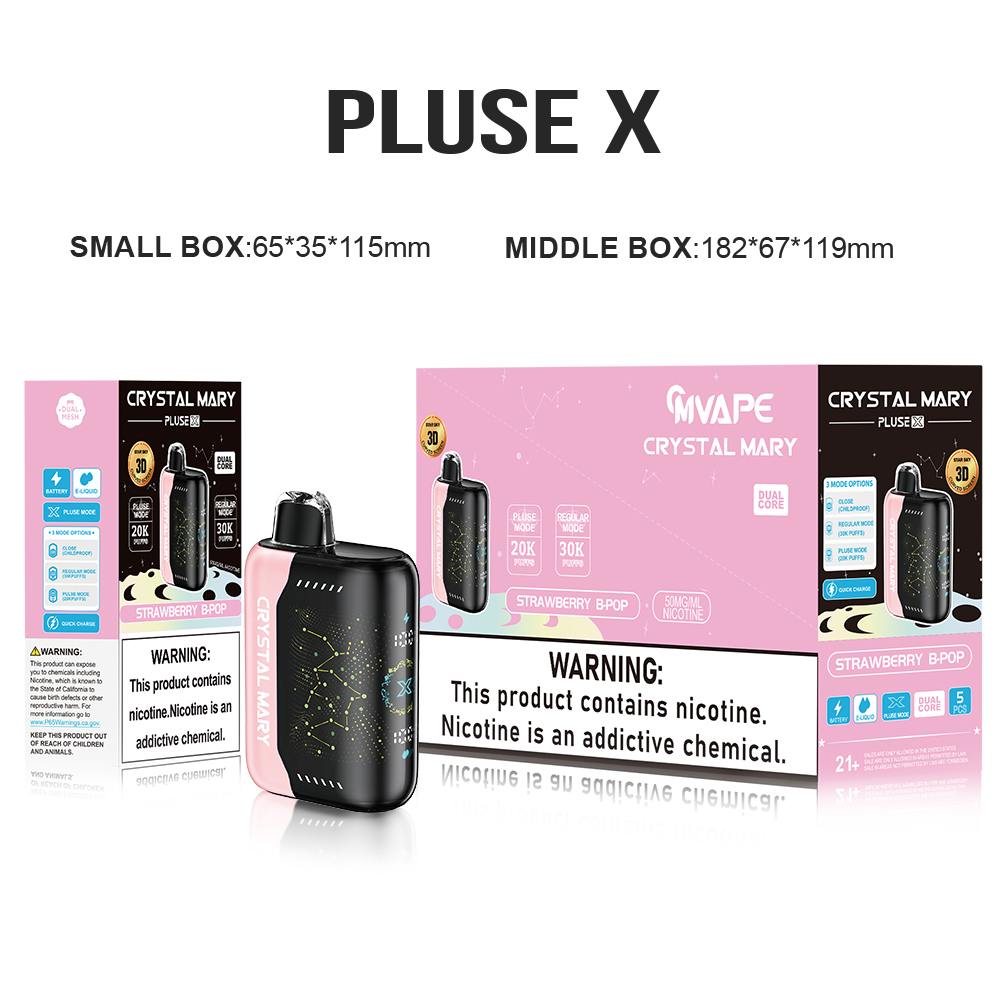
Crystal Mary lists the disposable CM-Pulse X in 2 percent and 5 percent nicotine versions. The 2 percent version is the lower strength choice in the published disposable range. Product details also show a 23 mL e-liquid capacity, an 820 mAh battery, and a stated 30,000-puff rating. Real puff count varies with draw length and use conditions.
Buyers comparing Crystal Mary products should confirm the exact nicotine label and legal status for the target market before ordering. Our products use mesh-coil heating, draw activation, leak-control design, and production checks meant to support steady operation. These are adult products. Market rules on capacity, flavor, and nicotine still apply.
FAQ
Q: What is the lowest nicotine level in a disposable vape?
A: Zero percent nicotine is the lowest concentration level available. For nicotine-containing disposables, 1% or 10mg/ml is below the typical concentration of 2% or 20mg/ml.
Q: Is 2% nicotine a lot in a disposable vape?
A: It equals 20 mg per mL. It sits below 5 percent, yet it remains addictive and marks the legal maximum in some regulated markets.
Q: Is a 1% disposable vape available everywhere?
A: No. Availability depends on local law and supplier range. Check the package for both 1 percent and 10 mg per mL rather than assume low has one fixed meaning.
Q: Does lower nicotine mean fewer puffs?
A: No. Nicotine concentration and puff capacity are separate specs. Battery size, e-liquid volume, power, airflow, and draw length set real device life.
Q: Can a low nicotine disposable help me quit?
A: A lower strength may support a personal reduction plan. A disposable vape is not automatically an approved quit treatment, though. A clinician can suggest evidence-based support and regulated medicines.


